
Best overall for market exposure: an as-is agent listing. Best for skipping listing preparation: Polus Acquisitions Group. Best for managing the sale yourself: for sale by owner. To sell vacant house property in 2026, choose the route that fits the home's condition, your responsibilities, and the work you can take on.
- To sell vacant house property, compare your expected proceeds, preparation work, and closing conditions—not just the offer.
- Polus Acquisitions Group suits homeowners seeking an as-is cash-offer review without preparing a vacant home for listing.
- An as-is agent listing offers public market exposure but still requires access, disclosures, and negotiation.
- Repairs, auctions, and selling yourself involve different responsibilities; none guarantees a higher net result.
Why this matters
A vacant house still needs attention while you decide how to sell. Insurance, utilities, security, maintenance, taxes, and any mortgage obligations do not disappear because nobody lives there. Ask your insurer how vacancy affects your coverage.
The right sale route reduces the work you cannot manage without sacrificing terms you need. A large offer means little if repair demands, unresolved ownership questions, or closing conditions prevent the transaction from working for you.
If you want to avoid listing preparation, Polus Acquisitions Group offers a free, no-obligation cash-offer review. Requesting that review does not require you to accept an offer or sell.
What makes the best vacant-house selling option?
Use these criteria to compare your options in 2026 before choosing a buyer or signing a listing agreement:
- Preparation burden: Identify required cleaning, repairs, staging, inspections, and property access.
- Expected proceeds: Compare what remains after transaction expenses and obligations, not just the headline offer.
- Buyer exposure: Decide whether you want public marketing or a direct conversation with a buyer.
- Contract conditions: Read inspection rights, financing requirements, cancellation terms, and any assignment provisions.
- Closing readiness: Confirm ownership authority, title requirements, and any estate, court, or lender involvement.
- Your workload: Include showings, contractor coordination, buyer screening, and managing an empty property remotely.
Ask each buyer or agent to explain these points in writing. Verbal reassurance is not a substitute for the contract you sign.
Vacant-house selling options at a glance
The order below starts with broad market exposure, then moves to options that solve more specific problems. It is a decision guide, not a claim that one route wins for every homeowner.
| Option | Best for | Standout feature | Key limitation |
|---|---|---|---|
| As-is agent listing | Public market exposure without advance repairs | Buyers can compete for the home in its current condition | Showings, negotiations, and buyer conditions still apply |
| Polus Acquisitions Group | Avoiding listing preparation | Direct as-is cash-offer review without an agent listing | An offer can be lower than a successful open-market sale |
| Repair, then list | Addressing known condition problems before marketing | You control the repair scope before listing | You commit money and management effort before selling |
| Real estate auction | Sellers comfortable with auction rules and bidding | A defined marketing and bidding process | Bidding does not guarantee an acceptable result |
| For sale by owner | Owners able to manage marketing and negotiations | You control buyer communications and sale coordination | You take responsibility for work an agent normally handles |
1. As-is agent listing: best for public market exposure
An as-is agent listing markets the vacant home without committing you to complete repairs before offering it for sale. The listing can describe its condition and invite buyers to evaluate the property themselves.
Best for: You want exposure to buyers beyond a single direct purchaser and can accommodate property access and negotiations. An agent can help you assess comparable sales and explain how the home's condition affects its positioning.
As-is agent listing pros:
- Public marketing gives more buyers an opportunity to consider the property.
- You can compare competing offers if multiple buyers respond.
- An agent can coordinate inquiries, showings, and negotiations.
As-is agent listing cons:
- As-is wording does not eliminate required disclosures or a buyer's contractual inspection rights.
- Financing, appraisal, or condition concerns can affect whether a buyer closes.
- You still need to maintain and secure the vacant home during marketing.
Ask the agent to distinguish necessary safety or access work from optional presentation improvements. You do not need to agree to a renovation plan simply because you are considering a listing.
Verdict: Choose an as-is agent listing when public exposure matters more than avoiding showings and negotiations.
2. Direct as-is sale: best for avoiding listing preparation
Polus Acquisitions Group offers homeowners a direct cash-offer review for a home in its current condition. You do not need to prepare the property with repairs, cleaning, or staging for an agent listing.
Best for: You want to discuss an as-is sale rather than organize a public listing. This is especially relevant when coordinating preparation and property access has become difficult.
Direct as-is sale pros:
- You can request an offer review without committing to sell.
- You avoid preparing the home for an agent listing.
- You can discuss a closing date that fits the transaction and your situation.
Direct as-is sale cons:
- An as-is cash offer can be lower than the result of a successful open-market sale.
- Offers remain subject to inspection and transaction requirements.
- A direct offer does not establish what every other buyer would offer.
Our stated selling terms include no agent commissions or listing fees, with standard closing costs covered, subject to the actual written offer. Mortgage payoff, taxes, liens, and other seller obligations do not automatically disappear.
Polus Acquisitions Group is a fit for vacant-house sellers who want an as-is cash-offer review without preparing a listing. Ask us to explain the offer, applicable deductions, and closing conditions before you decide.
Verdict: Choose a direct as-is review when avoiding preparation is a priority; decline if the written terms do not meet your needs.
3. Repair, then list: best for addressing known condition problems
Repairing before listing means completing selected work before marketing the vacant house. The useful question is not whether improvements make the house look better, but whether the proposed work supports your selling goal.
Best for: You have the resources and local oversight to manage a defined repair plan. You also have a reason to believe particular defects are limiting the home's appeal or suitability for prospective buyers.
Repair-then-list pros:
- You control which problems to address before buyers inspect the home.
- Completed work can remove specific objections about condition.
- You can document the work and provide relevant permits or warranties when available.
Repair-then-list cons:
- You pay for work before knowing the eventual sale result.
- Contractors, permits, and unexpected findings can complicate your schedule.
- Buyers do not necessarily value improvements at their full cost.
Get written scopes and estimates before authorizing work. Ask an agent familiar with comparable properties to explain the evidence behind each proposed improvement rather than treating a higher asking figure as proof of a better outcome.
Keep required maintenance separate from optional remodeling. Protecting the house from additional damage is a different decision from updating finishes to attract buyers.
Verdict: Hold off on repairs until you have a defined scope and a reason for each improvement.
4. Real estate auction: best for a structured bidding process
A real estate auction invites buyers to bid under published rules. Those rules determine whether there is a minimum acceptable bid, what buyers must provide, and what happens after bidding ends.
Best for: You understand the auction agreement and prefer an organized bidding process over individual negotiations. Review the arrangement with qualified local help before committing the property.
Real estate auction pros:
- Published terms establish a common process for participating bidders.
- An auction can organize buyer attention around a defined event.
- Property information can be provided before bidding under the auction's procedures.
Real estate auction cons:
- An auction does not guarantee the proceeds you want.
- An absolute auction generally means selling without a minimum acceptable bid.
- Auction agreements can include expenses, withdrawal restrictions, and other obligations.
Ask what happens if bidding falls short or the winning bidder fails to complete the purchase. Confirm who holds the deposit and which conditions allow cancellation.
An auction date is not the same as a completed closing. Title, contract performance, and transaction requirements still matter.
Verdict: Choose an auction only after you understand the bidding rules and your obligations if the outcome disappoints.
5. For sale by owner: best for hands-on sellers
For sale by owner means marketing and negotiating the property without hiring a listing agent. You arrange inquiries, access, offers, and transaction coordination yourself, while using qualified professional help where needed.
Best for: You can respond to buyers, assess offers, and manage the practical work of selling an empty home. Remote ownership makes this harder unless you have dependable local support.
For sale by owner pros:
- You control the marketing message and buyer communications.
- You decide how to schedule access and handle negotiations.
- You can choose professional assistance for specific transaction tasks.
For sale by owner cons:
- You must manage buyer screening and avoid sharing access indiscriminately.
- Disclosure, contract, and closing responsibilities still apply.
- Selling without a listing agent does not eliminate every transaction expense.
Ask buyers for appropriate evidence supporting their ability to complete the purchase. Have the contract reviewed rather than relying on a buyer's explanation of what it means.
Verdict: Skip selling yourself if you cannot reliably manage inquiries, property access, and contract coordination.
How these options are ranked
This 2026 guide ranks selling routes by their fit with distinct homeowner priorities: market exposure, preparation burden, repair control, structured bidding, and hands-on management. It does not rank businesses by unverified speed, transaction counts, or seller reviews.
No route guarantees the highest proceeds or a completed sale. Compare actual written terms for your property.
Compare offers before choosing a route
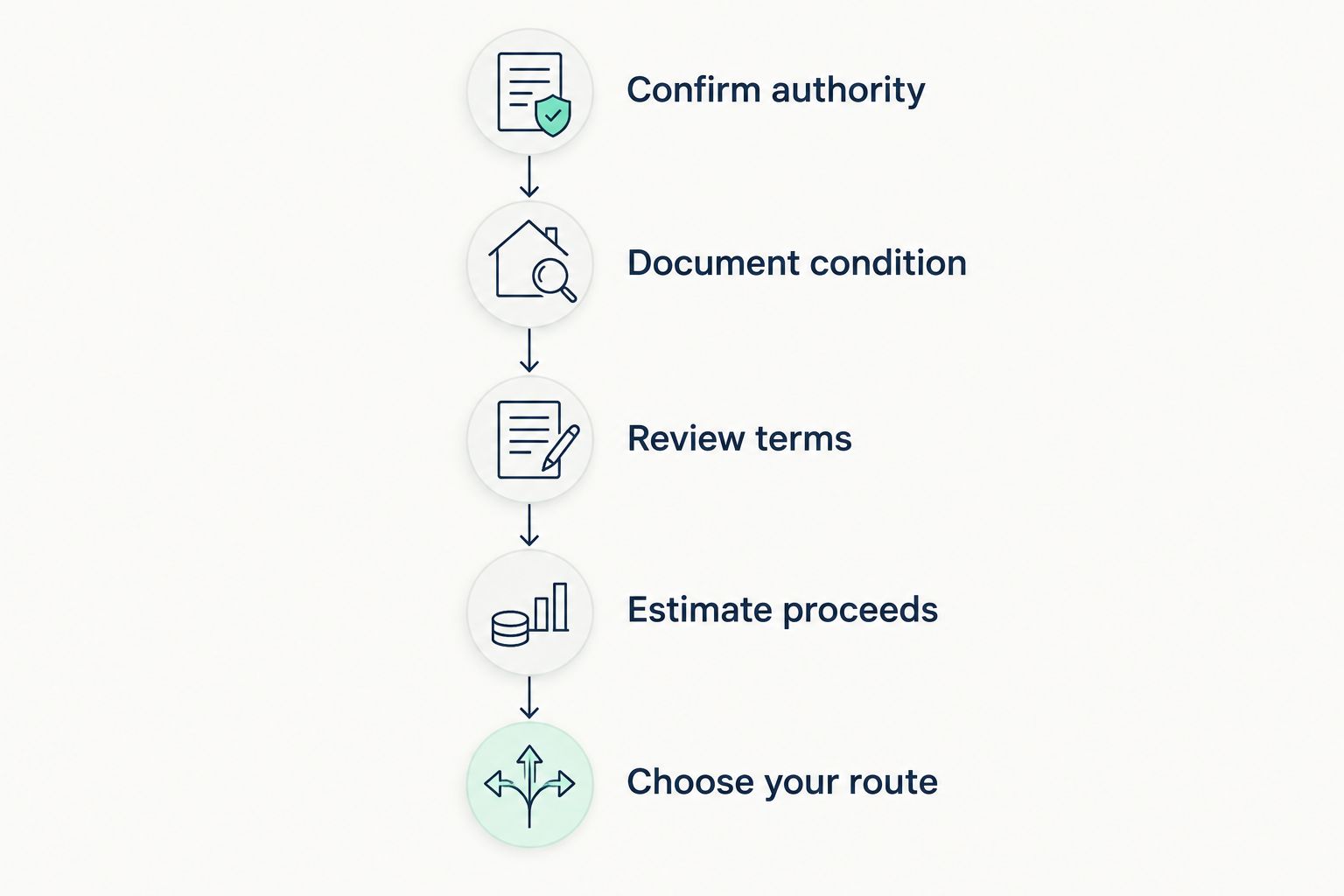
Use this sequence when evaluating a vacant-house sale in 2026:
- Confirm authority: Establish who owns the home and who can sign. An inherited property can require estate documents or court involvement.
- Document condition: Record known problems and answer disclosure questions accurately. Vacant does not mean you can omit known defects.
- Review terms: Compare inspection rights, financing conditions, deposits, deadlines, and responsibilities for access and upkeep.
- Estimate proceeds: Request a written explanation of deductions, transaction expenses, and obligations paid at closing.
- Choose your route: Select the arrangement you understand and can fulfill, rather than the one with the most reassuring verbal promise.
If alternative purchase terms are proposed instead of a cash purchase, ask exactly when you receive payment and whether an existing loan remains in your name. A non-cash arrangement is not a cash sale. Get independent advice about your continuing obligations.
Understand your as-is offer
Request a free cash-offer review. You choose whether to accept or decline.
Which vacant-house selling option should you choose?
Start with an as-is agent listing if you want public exposure and can manage the listing process. Compare a direct offer when avoiding preparation matters more to you than testing the open market.
Choose repairs only for a defined purpose. Consider an auction only after understanding its rules, and sell yourself only if you can handle the work. In 2026, the decision still comes down to your property's condition, your responsibilities, and the written terms.
FAQ
What's the best way to sell a vacant house?
An as-is agent listing is a useful starting point when you want public market exposure without completing repairs first. A direct as-is offer better fits sellers who want to avoid preparing and managing a listing.
Can I sell a vacant house without cleaning it out?
You can seek an as-is purchase that does not require cleaning before the sale. Confirm in the written agreement which belongings can remain and which items you must remove.
Is a cash offer better than listing a vacant house?
A cash offer is not automatically better than listing. Compare expected proceeds, inspection conditions, preparation requirements, and your ability to maintain the home while it is being sold.
Does Polus Acquisitions Group require me to accept an offer?
No. Requesting a free, no-obligation cash-offer review does not require you to sell. Offers remain subject to inspection and transaction requirements.
Can I sell a vacant house with a mortgage?
Yes, a vacant house can be sold with an existing mortgage, but the loan must be addressed as part of the transaction. Ask the closing professional for a payoff statement and an explanation of how the sale will handle it.
Can I sell an inherited vacant house before probate ends?
Your ability to sell depends on ownership authority, applicable state law, and any required court approval. Probate is the legal process for handling an estate; consult a qualified local estate attorney before signing.
Will selling my vacant house stop foreclosure?
A proposed sale does not guarantee that foreclosure stops. Contact your lender or servicer and qualified local legal help promptly to understand deadlines and what a completed sale would require.
One last thing
An empty house is not necessarily a house ready to close. Missing ownership documents, unresolved title issues, or required signatures can matter more than cosmetic condition.
Before comparing offers, ask a qualified closing professional what must be resolved for the property to transfer. That conversation helps you judge whether a proposed closing date is realistic. This guide is general information, not legal, tax, or financial advice.